Our new and improved site

(with the same content as this one, AND MORE!) is

www.The SharingGardens.blogspot.com/

Showing posts with label fertilizer. Show all posts

Friday, May 4, 2012

Grass Clippings and Leaves for Fertilizer/Mulch


photo: Muhammad Sajjad
Turning over a new leaf
Leaves, grass clippings and other yard "waste" make excellent fertilizer for garden soil. We have been demonstrating this at the Sharing Gardens with vegetable yields in the tons (2012 Harvest Totals). My husband Chris also demonstrated a great increase in fertility using yard "waste" on his 5-acre farm in the high-desert country NE of Mt. Shasta, California (back in the 1980's - '90's). Within a short amount of time, using only leaves and grass clippings, alfalfa-powder that he collected from the floor of a pellet mill nearby, and a modest amount of goat and chicken manure from his own livestock, Chris turned volcanic soil, the consistency of beach-sand, into a garden that inspired Organic Gardening Magazine to write an article about him called "Defying the Odds on a High-Desert Oasis" (March 1991). Chris' gardens were so bounteous and beautiful that his farm was nicknamed "Findhorn West!"

Feed your worms and other "micro-livestock" directly in the soil!
We have already written several posts that go into great detail about the simple methods we use at the Sharing Gardens, using local materials, to increase fertility (links below). In essence, our method is to feed the soil with leaves, lawn-clippings, spoiled hay and vegetable scraps, weeds and the plants we pull at the end of the season to feed the "micro-livestock" (worms, bacteria and other "composters"). As these garden-partners eat their way through the yard and garden "waste" we provide for them, they fertilize the soil with their manure and create minute tunnels that keep the ground from compacting.

Organic Matter, the "The First Amendment"
As our dear friend, James Cassidy (professor of Soil Science at Oregon State University) likes to say about soil health, no matter what challenges you are facing, the answer is always "add organic matter!"

Here is a step-by-step guide to one of the methods we use at the Sharing Gardens to increase the fertility and tilth of the soil using a lot of grass clippings combined with dry leaves.

Two to three weeks before planting in a bed, spread a layer of leaves and grass clippings and till them in.

1. Thinly distribute dry leaves over the surface of your grass. You want there to be more grass clippings than leaves in your final mix. It'll be much easier to do with dry leaves saved from the previous Fall.
Maple and fruit trees have thinnest leaves that break down quickest. Avoid walnut leaves as they will make your soil toxic to your seedlings. Oak and other thicker leaves work fine -- just mix in more grass clippings than with thinner leaves.

2. Run the mower over the leaves/lawn, using a catcher-bag to collect them. Set mower at a higher setting. Sometimes you may have to lift and lower mower to avoid stalling.
3. Distribute them about 1" - 2" thick in garden beds. You can till first, or lay the grass/leaves out and then till them in.

4. Till grass/leaf combo into the soil passing over the bed two to four times to work them in well.
5. Worms and soil organisms will decompose them enough in 2-3 weeks for you to begin transplanting.
6. Stand back and watch your vegetables grow!
You don't have to spend lots of money on soil amendments, to yield beautiful results!
Note: if you use plain, fresh grass clippings (no leaves), they can be quite hot, if laid on thick. If used as a mulch around plants, be sure they don't actually touch the stems or leaves of the plants.
John mulches lettuce and broccoli using fresh grass-clippings.
Other related posts from the Sharing Gardens:
Preparing Garden Beds - One Low-Tech Way

Hay-Bale Compost

More on Mulch

Mulch We Love, and Why 

Benefits of Deep Mulching

CLICK HERE for article (from your Organic Garden) about using leaves to build healthy soil.

Raking grass - a local resource.
But could it really be so simple? 
In the beginning (if you are starting with a new garden site), or even as you transition from using commercially available soil amendments, you may need to use a pre-mixed, organic fertilizer, or concentrated materials applied judiciously, in addition to leaves, grass clippings etc. For example, in the first years of the Alpine, and Monroe Sharing Gardens we used rabbit and llama manure (dried and sifted as part of our nursery/potting mix, or worked into the hole with transplants.) We used an all-purpose, organic fertilizer in this same way, along with some kelp powder (for minerals and micro-nutrients). At times we have also used fish, or seaweed liquid concentrates as a "foliar feeder" (diluted with water and sprayed on plants when they showed signs of mineral depletion or stress.) But our primary methods of maximizing the fertility of our soil have been through mulching deeply using locally available "waste products": Leaves, grass clippings and spoiled hay (wet or moldy hay that can no longer be used as feed or bedding for livestock).

Volunteers sharing in the harvest. Now that's local!
Taking local food production to a new level
One hot topic these days is "eating local".  A "locavore" is someone who endeavors to eat foods grown or produced within a certain radius (for example, 100 miles). There are many reasons a person might choose to eat more "locally" but one common reason is to live lighter on the planet by reducing the amount of fuel needed to transport food. While this is an important piece of the puzzle, it's also important to go a step further to look also at where the fertilizers and other soil amendments come from. Even if the food you eat travels less than 100 miles, if the soil was fertilized with products that came from half-way around the world, this radically increases the "carbon footprint."  Many of these soil amendments also involve aggressive mining, or extraction methods that are environmentally damaging and threaten the delicate balance of life. Many of the sources for these materials are in increasingly shorter supply, making the long-term use of them unsustainable. Also, for people who choose to eat a vegan, or vegetarian diet, their use in growing vegetables is undesirable (ex: feather-meal, bonemeal and other slaughter-house by-products).

Don't treat your soil like "dirt".
As an overall philosophy, we feel it is better to work with nature and cooperate with the processes of soil-building and fertility that have evolved over eons, than to assume the role of a soil magician, concocting potions and powders, mixes and methods that can be complicated, costly and often disruptive to the health of your soil. The good news is that most, if not all of these products can be supplemented, and eventually replaced by resources that are local, renewable and sustainable: leaves, lawn clippings, kelp concentrates (powder and liquid) and modest amounts of animal manure.

Finding local sources
If you don't live in an area that will deliver leaves, or you don't have a site big enough to warrant a full dump-truck load deposited, here are some other ideas:
  • Offer to rake your neighbors leaves in exchange for using them in your garden.
  • Approach your neighbors about bringing you their bags of leaves.
  • Organize a "leaf co-op" where a group of gardening friends rake and share the leaves they gather.
  • Organize your local scout troop, or 4-H, or youth group to spend a few Saturdays in a row raking leaves in the neighborhood. You can offer this service 'by donation' and collect funds for the youth group's other activities.
  • Put an add on 'Craig's List' requesting leaves.
  • Set up a site at the local dump or transfer station.
Collection station Chris set up at the local dump in Mt Shasta, CA (1980's).
This last solution is one that my husband Chris, implemented quite successfully at his previous farm. At that time, yard "waste" was a real issue as it took up valuable space at the land-fill and meant that they would have to close and find new places to dump the community's refuse. Also, in many rural areas, instead of paying dump-fees, many people gather their leaves and burn them which not only deprives the soil of these valuable nutrients but adds to air pollution as well. Chris made an arrangement with the dump's manager whereby he set up a chain-link enclosure as a collection-site for yard waste and had a separate area for nursery pots and flats. Whenever the enclosure was full, Chris would get a call from the manager, and go pick up the load.

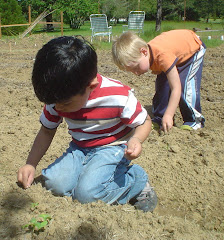
We're all just kids in the garden!
Whenever we write one of these "how-to" posts we try to add a couple of caveats: One is that, there are just about as many different ways to grow a garden as there are gardeners and this is just our way. Two: Gardening is a very dynamic process; each garden site is different, and each year the same garden site is different due to the weather and other shifting conditions. So, while these methods reflect what we're doing these days, check back in another year and see if we've evolved it further!

Please read our post about Herbicide Contamination of Compost, Manure and Mulch

Sunday, October 17, 2010

Garden Update - October 2010

Here's the latest of what's happening with the Alpine/Monroe Sharing Gardens - October 17, 2010.
This hoop greenhouse is the same size and style as the one we will be building for the Sharing Gardens
Greenhouse 
We are pulling together the support and materials necessary to build a 20' x 96' greenhouse. Chris has been building and managing greenhouses for over 30 years. We will be using a simple hoop-house design (pictured). If you are interested in learning how to build this style of greenhouse, or manage a nursery, let us know so we can keep you informed of volunteer sessions. Having a greenhouse of this size will extend the growing season of tomatoes and peppers by as much as three months (they will ripen earlier and continue later in the season). We will be able to grow enough "starts" for the gardens, for fund raisers and to give away at the food bank. We are grateful to Dorothy and Gary at Alpine Pump for providing us with hundreds of feet of used well-pipe for use in construction. We also have a donor (who wishes to remain anonymous) who has provided all of the 30-foot lengths of re-bar we'll be using for the greenhouse ribs. We are seeking funding for materials and stipend through several granting sources. All donations are tax-deductible.

Tomatoes, purple, yellow and green beans and a cucumber on their way to the food bank.
Harvest Heaven
In spite of a cold, wet spring, difficulties in getting our new garden-site sufficiently plowed, growing the majority of our "starts" out of an 8' x 8' greenhouse (thank-you Estell/Kreths!), the Sharing Gardens have had a remarkably productive second year. We kept a bathroom scale at the Monroe garden and kept a rough tally of the harvest as we delivered it to the food-bank next door. The gardens still have a week or two to go but here are just a few highlights of this year's harvest:

Tomatoes: 1,210 pounds (thank you Steve Rose and Larry Hammon for donating so many of the 200 tomatoes we planted this year.) Organic, heirloom tomatoes are selling for $4 to $5 a pound in our area.
Cucumbers: 575 pounds
String Beans: 220 pounds

"Moonglow" tomatoes - an heirloom variety
There were some crops that didn't do as well as we'd hoped. We planted four different corn crops at the Monroe garden and the crows ate the sprouting seeds for all but one crop that we had sprouted in the greenhouse and transplanted. We had high hopes for the potato crop as we had carefully "chitted" such a huge quantity of seed-potatoes. The time came when we just couldn't wait to put them in the ground any longer but the ground was still so wet and heavy. We'll need a different strategy on both crops in 2011.

A happy harvester, picking out his pumpkin
Community Celebration:
Every third Thursday, the United Methodist Church hosts a free dinner open to everyone who would like to attend. Cash donations are welcome (though not required) and, side dishes/desserts are always appreciated. Please come join us for a harvest celebration and meet neighbors you never knew you had! Food Bank is from 5:00 to 7:00 pm. The Community Dinner begins at 6:00 pm in the basement of the United Methodist Church: 648 Orchard St., Monroe, OR 97456

Gallery of Givers: Our volunteer team has been wonderful this year. We truly could not have done it without them. Here are some faces of some of those who have been willing to get their hands dirty, showed up week after week - regardless of weather, and sometimes arriving as early as 8:30 in the morning to be sure the harvest was in, in time for the food-bank's opening. We are also so grateful to all the behind-the-scenes support we have received through grants, donations and kind words spurring us on.
Rann and Doreen in the bean tipi
Steve N. watering the transplants
Llyn's mom, Judy, harvesting tomatoes
Jim and Norma harvesting beans
Rann and Bruce fertilizing the plants
Ryan and Cindy in the raspberry patch
Dustin, Lexi, Llyn and Dylan in the bean patch
The Mulch Brigade!
Harvest morning in Monroe

Tuesday, August 24, 2010

The benefits of deep mulching

Deep mulching produces a bounteous harvest!
Here in the Sharing Gardens we practice a style of gardening known as "deep mulching". Just as it is rare to find bare soil in nature, in our gardens you won't find much exposed soil either. We use the materials that are easily available in our area (grass clippings, leaves and spoiled hay) and let nature do the work of increasing the garden's fertility. People who raise livestock such as cows, goats, chickens and rabbits know how important it is to give appropriate food, water and shelter to keep their animals healthy. In turn, these animals produce by-products that are beneficial to the people who care for them, not the least of which are the nutrient-rich manures used as the basis for many commercial fertilizers. In the Sharing Gardens, we tend to "livestock" on a slightly smaller scale. Worms, fungi, beneficial insects and bacteria are the micro-livestock we care for with our heavy mulching. They, in turn, provide a natural balancing of the soil along with castings and other "waste products" that feed the plants' rootlets right where they need it most.

Mulching feeds your "micro-livestock"

In these first years of establishing new garden sites in Alpine and Monroe, we also use a high-quality organic fertilizer, our own worm-castings compost, and rabbit and llama-doo applied judiciously to the plants that need a boost. But we don't apply any single concentrates of nutrients such as lime or gypsum as we have found through years of gardening experience that a garden's soil can get seriously out of balance through the application of these concentrates.

What materials make good mulch?  It is best to choose materials that are readily available in your local area. Urban gardeners may find that leaves and grass clippings are easiest to come by. Many cities will actually dump a load of leaves for personal use if you have an adequate drop-site. Do be aware that you can't be 100% sure of the kind of leaves you're getting. There is also likely to be some residue from oil and other materials from motorized vehicles (though probably not enough to be very concerned about). You'll need to be sure and use good gloves in distributing city-leaf piles as its possible that broken bottles or other sharp trash could be mixed in. Hand-raking leaves is our favorite method for gathering this valuable resource. Leaf-raking gives you a great work-out without being too strenuous (we call it "rakey" therapy -ha.) You can use tarps to haul the leaves to your garden, or bag them in leaf-bags. Sometimes we have stored leaves in rings we crafted from fencing, or just made a deep pile and tarped it for the winter. This latter option produced very rich, yummy, decomposed leaf compost by the following spring. The thinner the leaf, the easier it breaks down. Maple is our favorite. Oak takes a long time to break down and we wouldn't recommend using it unless you mix it with other types of leaves. Fruit-tree leaves are also great. Don't ever use walnut leaves as they have natural substances in them that are poisonous to plants and will destroy your garden's fertility.
Maple leaves make excellent mulch

If you live in, or near the country, spoiled hay makes a great mulch. Many farmers have hay from previous seasons that has become wet or moldy or otherwise unsuitable to feed to their livestock They will usually be glad to have you haul it away for free, or very little per bale. If you don't have a trailer, you might be able to arrange for the farmer to bring it to you if you give him something for his gas and time.

Another rural source for excellent mulch is to clean out the stalls of goats, sheep, cows or horses. It's ideal if their bedding material is straw. If wood chips or saw dust is their bedding, you'll only want to use it if its been composting for a year or more. The heavy balance of carbon in the wood-products can actually leech nitrogen from your soil..

A delivery of spoiled hay

When to mulch? In the cycle of a year's gardening, there are two main times for a mulch "push". At the end of harvest, when you're putting your garden to bed, if you have a large enough quantity of grass clippings, raked leaves or animal bedding from cows, goats, sheep or horses that has manure mixed in, you can apply this liberally and roto-till it into the ground. This gives you the whole winter for the micro-livestock to digest it in time for spring planting. It is not a good idea to till your mulch into the ground in the spring time because the "browns", the more woody/cellulose aspects of the mulch that are high in carbon will bind with the nitrogen in your soil and effectively rob it from your spring seedlings if tilled in too close to their planting.

The second cycle of mulching begins in the spring and continues throughout the summer as you plant your garden rows. In our gardens, we have used a roto-tiller to loosen the beds and then mounded them into raised beds by hand or with a tractor. In future years, as the soil improves through the addition of organic matter (hay, leaves etc), and the worm colonies have become well established, we may be able to maintain these beds just using a broadfork (a human-powered tilling tool that is less disturbing to the soil).

Why mound the soil? We take the time each year, to mound the soil into raised beds for several reasons. As you can see from the photo, in the wetness of the Pacific NW spring, it keeps the roots from drowning by raising them above the water table. Also, if your rows run east to west, the whole south side of them faces the sun which can significantly warm the soil temps; another great advantage to most seedlings' early growth. The mounded soil doesn't ever get walked on so, over several years, if you maintain your rows in the same spaces, this soil becomes very light and fluffy, with good "tilth".
Advantages of raised beds...
If you're using all that hay and grass clippings, what about weeds? This is a question we get asked a lot. Bringing a whole bunch of hay into your garden may not seem like a good idea as you also bring a bunch of weed seeds that can then germinate in your garden soil. They key is in applying enough mulch, soon enough. In our Alpine plot (80' x 100'), in the first year, our friend was able to till the ground a good 8" deep thus killing all the grasses/weeds already growing at the site. We mulched heavy and early and, in the whole season we probably weeded about a five-gallon bucket's worth of weeds out of the whole garden. No kidding. For contrast, in the Monroe site, because of a very wet, cold spring and the urgency of moving ahead and simply getting some things planted before the soil had had time to drain sufficiently for deep tilling, the ground was only tilled about 4" deep. Many of the weeds and grasses were only "scalped" and came back strong in the garden beds, so we have pulled many wheelbarrows full of weeds out of that garden. But the weeds are only coming up in the garden beds themselves. In the pathways that are heavily mulched, the weeds exhaust themselves before they can grow up to the light. As they die, they become mulch too and their rootlets provide yummy snacks for the worms to follow along as they work the soil.

How much is enough? You want to put enough of the material to keep in the moisture and block the sun from reaching any weeds growing in the paths. Hay bales often naturally break into "flakes". Just lay these in your paths, end to end, without fluffing them (which can scatter seed into your beds) and make it easier for weeds to grow through (5" to 8" is ideal). If you're using dried leaves, they too should be about 6" thick. Grass clippings work best if you put them locally around the base of plants (leave about a 2" gap around the  stem of the plant). When applied liberally in the paths they can form a gooey surface that can be quite slick and dangerous to walk on. They also become "felted" or matted down making it harder for water to seep through to the plant's roots. You'll be amazed to see, over the course of a year, that the 8" of mulch you applied in May, June or July, will be almost totally digested (from below) by the following March/April when you begin the spring plantings. Worms travel up to the surface of the soil at night and feed on the mulch, carrying it back down into the soil in their gullets and distributing it as castings throughout your garden.

Alpine Garden - 10 weeks after breaking ground 2009

 A summary of the benefits:
  • Keeps moisture in (less watering). Though when you water, you must water long and deep to be sure the water penetrates down through the mulch and into the soil. In our Monroe garden, we have gone over two weeks without watering in the heat of August but we watered each section of the garden for over two hours at the beginning of those two weeks. When you're first planting a bed - with seeds or transplants, you need to water more often till the plants are established. To check if you need to water, lift mulch in the paths and check for moisture level in the soil. You can often see red worms and tiny rootlets extending from the plants growing in the beds.
  • Keeps weeds down.
  • Balances your soil-nutrients (your "micro-livestock" keep things balanced without you having to figure it all out.)
  • Moderates day/night temperature fluctuations in the soil.
  • Adds organic matter to keep soil from becoming too sandy or clay-bound.
  • It's very comfortable to sit or kneel on as you cultivate and harvest your plants. (We had a photographer come to our gardens once and said it was "the most comfortable" garden she'd ever been in!)
 Sources for mulch:
  • Municipal leaf-gathering
  • Raking your own (offer to rake your neighbors' in exchange for keeping the leaves.)
  • Farmer's moldy or spoiled hay
  • Set up your own collection site: Rural transfer stations appreciate any solution that keeps material out of the landfill. Below is a picture of a collection site Chris established near his farm in northern California. 
A gathering site for mulch donations at the local, rural transfer station.
Here are some other pictures of our gardens showing the deep mulch technique:

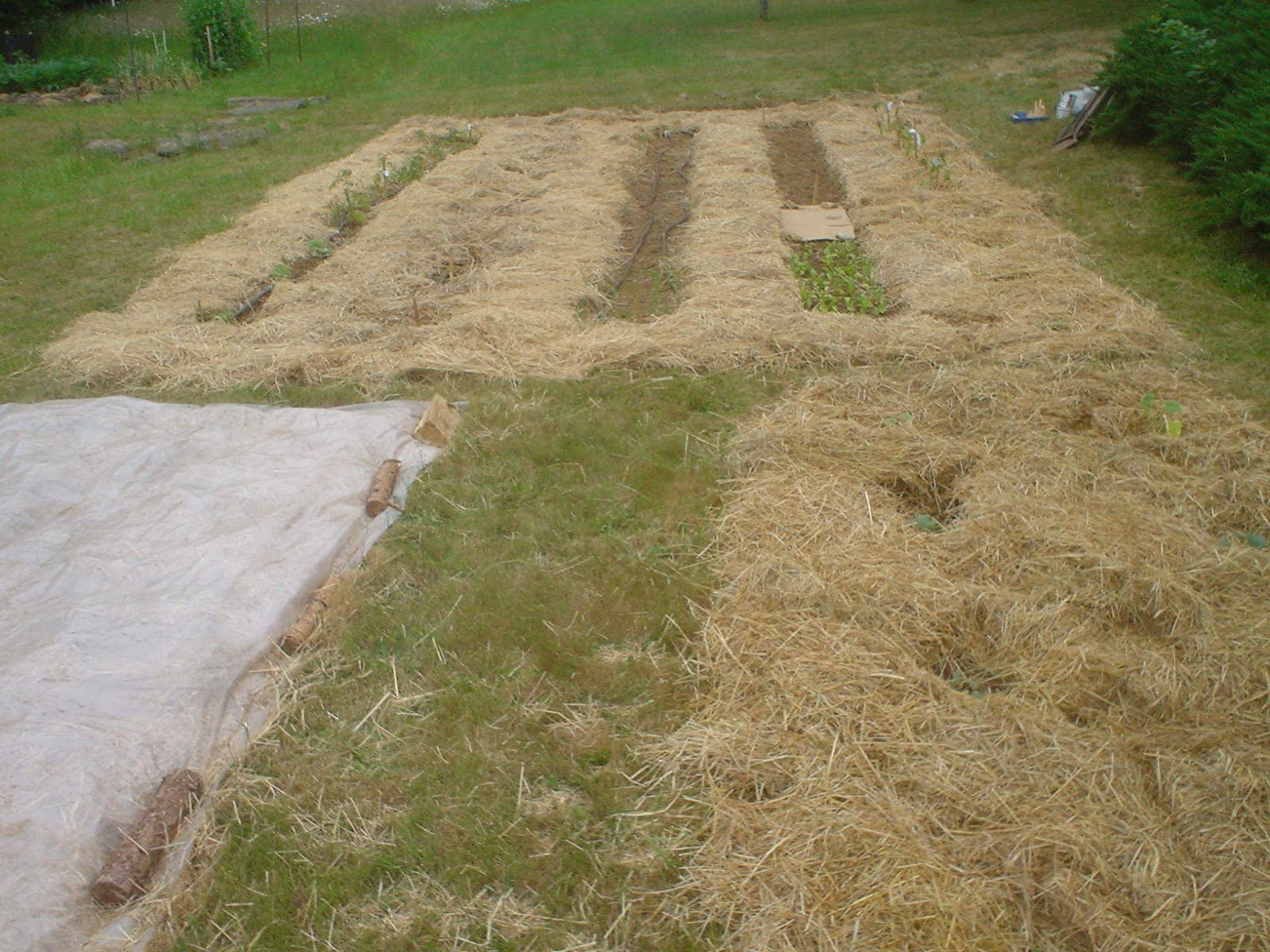
Another example of how the garden looks--fully mulched--with hay.
Tilling in leaves in the fall - so they have time to decompose by spring.
The potatoes were mulched first with leaves and we're adding oat-straw in the picture.
This was a "lawns-to-gardens" project where we simply scalped the grass from the beds and mulched the lawn path-ways. The plastic on left was placed to "solarize" the grass (kill it in preparation for fall-crop planting).
Here Chris is using lettuce that has "bolted" (gone to seed) as mulch in the potato patch. Oat straw was then placed over it.
Fun in a leaf ring! (Robin, Chris' son in a "nest" of leaves1996)
Please read our post about Herbicide Contamination of Compost, Manure and Mulch

Wednesday, June 16, 2010

Hay-bale compost, Wish-List and Gratitudes

Hay-bale, slow-cook compost pile
One of our readers noticed this picture on our website of a hay-bale compost bin and was curious about making one. This kind of compost pile is ideal for the following conditions:
  • You have plenty of room (depending on size of hay bales, its "footprint" can be as big as 5' x 8').
  • You have enough time to leave it alone for several months while it slowly decomposes.
 If your situation meets these criteria, here's how to make one: 

 Make a box of hay-bales.

Important: Before you make a hay-bale compost bin, please read our post about Herbicide Contamination of Compost, Manure and Mulch

You can start this hay-bale compost any time of year but its ideal if you make it in the fall as you're putting your garden to sleep for the winter and will have large quantities of plant-matter. Lay your hay-bales in a rectangle, one layer high. As you pull up your squash, corn, tomatoes etc toss them in the pile. If you're putting in "woody" material or thick stalks (corn, sunflower etc) they will break down faster if you cut them into smaller pieces with a machete or pruners. Mix in some rotting apples or kitchen scraps (vegetable matter only please) to attract red wriggler composting worms. Since the pile will shrink by at least half over the winter, pile it high, stomping it down as you go. Put a tarp over the pile once the winter rains start and by spring you'll have a beautiful pile of organic matter to nourish the new plants you're transplanting into the garden.

Sifted compost to nourish transplants - put a big handful in as you plant them.

Do not put in grasses from your garden that can grow from bits of their roots. For example: Bermuda grass or Quack grass etc. This is a slow-cook pile and its not hot enough to kill these weeds. If you put them in the compost you will then spread them all through your garden when you "harvest" the compost!

Sifter with hinged legs. It can be moved to sift different piles of material in your garden.

One last step... In order to separate out the composted goodies from the materials that didn't break down over the winter, you'll need to make a sifter. Chris built the one above from lumber scraps we had leftover from other projects and some half-inch "hardware cloth" (wire mesh). The legs are attached with hinges so it can be folded up to move and also set at different angles. A simpler sifter can be made to fit over your wheelbarrow or garden cart - half-inch holes are ideal. Using our sifter, we place a tarp below it. You'll find it will work best if you use a spade-fork to break the compost pile into smaller clumps before tossing them onto the sifter.


The hay bales rot and decompose throughout the whole winter and make incredible sheet-mulch to put around your transplants in the spring. You'll notice as you peel off the 2-3 inch "flakes" (they're pretty gooey by spring-time!) that they are full of red worms, their eggs and castings. Your spring garden now will be infused with a new, healthy population of these mini-livestock. 

You will likely have many "volunteers" from the seeds of the plants you threw into your compost pile in the fall. Don't worry!You can easily weed them out if they come up in your garden beds.


Unsung heroes!

Important: Before you make a hay-bale compost bin, please read our post about Herbicide Contamination of Compost, Manure and Mulch

And now for local news:

Our current wish list: Our biggest need now is for a large quantity of spoiled hay and/or grass clippings (for mulch). Ideally we'd appreciate it if you can deliver them to the Monroe site but if you have materials and no transportation, perhaps we can gather a crew to come pick up your donation.  Give us a call if you can help us. Chris and Llyn - (541) 847-8797


Extra plants to give away: There are some tomato starts, SMR 58 Pickling Cukes, two Red Kuri squash (a winter/storage variety) and a few pots of chives that need homes. Look on the picnic table behind the picnic pavilion at Alpine. Please don't take plants off any other tables or out of the garden as these may be donations to the garden we haven't seen yet. We had over 250 onion sets that were left on a different picnic table...if you took them by mistake and haven't planted them in your garden yet, please bring them back or share the harvest with your friends and neighbors (smile).

 Gary Watts mowing Alpine Chapel Park

We have much to be thankful for this month, in spite of spells of rainy weather, volunteers Rann and Doreen have showed up weekly to help us with making tomato cages, transplanting and mulching the gardens. Gary Weems has continued to assist with the construction of the garden shed in Alpine. With just a bit of trim-work and painting, it's done. We've already begun filling it with tools and garden supplies. Steve Rose, Larry Hammon and Greg and Marilyn Palmer have donated a variety of tomato plants to the gardens. We've planted as much as we have room for (close to 200 plants!) and there are still some left over. Jan Fanger donated some interesting blue and red sprouting potatoes which we'll be planting down in Monroe. We've got a whole neighborhood effort bringing us grass clippings in Alpine: Thanks to: Curtis, Aubrey, Phil and his partner Jorie for helping us keep Alpine mulched. Bud Hardin has come on board with a generous $200 donation, fencing material we're using for tomato cages and a huge load of pots and flats for the greenhouse. Gary and Dorothy - of Alpine Pump spent a good portion of their day mowing the Alpine Park with a mower loaned to us from Diamond Woods Golf Course-great job you guys!  Jack Jones showed up that same day and tinkered on our donated lawn-mower to help us get it running better

 Dorothy Brinckerhoff mowing the center-lawn at Alpine's garden
Evelyn Lee donated us a string-trimmer she no longer needed and we've got that running now. Renee Duncan answered the call for a person to oversee the perennial beds in Alpine. We'll be using the volunteers' back-power to help her keep the flowering shrubs and flowers beds looking nice but its great to have someone oversee things. Renee also contributed some squash and pumpkin plants. Chester Crowson had a new pump installed at the Monroe site. We'll have 10-15 gallons a minute down there which will be great once summer finally gets here! Last but not least, Eva Fife has found a Philomath connection for some horse poop which she loaded and delivered to the Monroe site. The squash plants thank you, Eva! As you can see, the gardens are truly becoming a community effort. We do our best to acknowledge everyone personally for their contributions. If we have overlooked you, please send us an email so we can include you in the next post. Every bit helps!

Jack Jones tinkering with mower donated by Ray Kreth and Mylrea Estell

Tuesday, May 11, 2010

Potatoes in the Ground!

 (To read a compilation of all our potato blogs, go to:
Can I plant potatoes from the grocery store? and

Some people who are following this blog have been "chitting" potatoes to increase their storage of solar energy and make their sprouts tougher prior to planting. This post covers how to plant your potatoes. If you've got some potatoes that are eager to get in the ground, here's a simple method that yields good results. (As with all gardening techniques, there are about as many ways to plant potatoes as there are potato varieties - and that's a lot! What follows is just one way that we've found works well for us. Feel free to add comments to our web-page with your own best tips and methods.)

Potato leaves emerging from the soil
Begin by roto-tilling the soil, or loosening it up so the potatoes have light, loose soil to form in. If the ground is too firmly packed, your potatoes will tend to be smaller. If you're planting more than one row, stake the rows about 36" apart. We use wooden stakes at the end of each row and baling twine we've recycled and tied together to form a long string. This will help you plant straight rows.

Baling twine saved from hay-bales, tied together for re-use in the garden
Using a clam-shell post-hole digger, dig your holes about 8"-10" apart and about 10" deep. You have to wait until your soil is drained enough so the fence-post digger doesn't get caked up with mud. If you just can't wait, and the mud is a problem, try filling a 5-gallon bucket with water and dipping the clam-shells in it between holes. This should help keep the mud from building up.

Digging holes with a clam-shell post-hole digger
Put some fertilizer in each hole - about 2 heaping tablespoons ( a small handful). We use an all-purpose, organic mix that we get from a local supplier called "Down to Earth" in Eugene. It's OK to put it straight in the hole. It won't "burn" the potato plants. You can use a big handful of worm-compost instead of fertilizer, if you have some. It helps if you're systematic: first dig all your holes, then fertilize, then plant them all. This gives you economy of motion and, if the holes are all prepared, your potatoes won't be shocked through excessive exposure to sun and air. 

Worm compost to fertilize the growing potatoes
This year we chitted potatoes in March and April, and then layered them in leaves so they didn't become dehydrated before we put them in the ground. Because we've had such a wet spring and we've had to wait so long, many of the potatoes had begun to send out long shoots and tiny rootlets. While it is important to expose potatoes to the sun when you first chit them, that same exposure can be devastating if they have begun to form fine root-hairs. If they get dried out from direct exposure to sun and air, at this stage, it can set them back considerably from their ability to produce potatoes.  Very carefully tease the potatoes out of the leaf or straw mulch you've stored them in. The ideal time to plant your potatoes is before they've grown fragile stems and rootlets but, if nature hasn't been cooperating and they've grown too far, just be very gentle. Don't get too far ahead of yourself. Only tease out as many potatoes as you have dug holes for. Don't leave any exposed to the sun or air. Cover them if you must attend to something else for awhile. Place a seed-potato in each hole.

Note the long sprouts and fragile, skinny root-hairs
The next step is to cover and mound the potatoes. Using a flat rake, gently pull the soil back over the hole and build it up into a raised bed at least 6" above the path and a foot or so wide. This will give you foot-wide paths for mulching. The advantage of raised beds is that they are able to catch more sun, the soil heats up and drains better and plant-growth is increased.

Heavily mulching the paths feeds the soil, keeps moisture in the ground and prevents weeds from growing.
Lastly, lay down a nice, thick layer (about 6") of mulch in the paths. You can use last year's leaves (no walnut please--they're toxic to plants), or straw, or spoiled hay. For more about the heavy-mulch method that we use for gardening, you'll just have to wait till we have time to write that post! If the potato leaves poke through the ground before the risk of frost has passed in your area, be sure to loosely cover them with these mulch materials on cold nights. Potatoes are very sensitive to frost. There's not a whole lot more to do with potatoes until harvest time. If you notice the forming potatoes pushing up out of the soil, be sure to cover them with more soil or mulch to keep them from turning green (green potatoes are poisonous).


Anticipate the harvest!