Our new and improved site

(with the same content as this one, AND MORE!) is

www.The SharingGardens.blogspot.com/

Showing posts with label garden's progress. Show all posts

Monday, January 9, 2017

Winter at the Sharing Gardens

Our newest greenhouse - the Sunship - Sept. 2016
Greetings everyone! Here we are heading into our ninth year with the Sharing Gardens, Can you believe it? From our humble beginnings at Alpine Park, with an 80'x80' garden-plot, an 8'x8' greenhouse, a handful of tools and willing spirits we've grown to the thriving, expanded project we are today.

In the beginning, we didn't even have pictures to use on our website so borrowed photos Chris had taken in previous gardens. LINK to first Post - A Seed is Planted Our readership has steadily grown over the years and is currently experiencing a surge in readership that peaked with over 17,000 site-visits in December 2016 alone! It has tapered off slightly since this peak but we are still averaging 300 visits per day. These visits come from all over the planet both for practical gardening knowledge and for inspiration about the power and joys of generosity.

Home-grown dinner!
This post features info about what happens at the Sharing Gardens during the winter months. Enjoy! From December through about mid-February, activity in the gardens is minimal. Here in the Willamette Valley of Oregon, our winters are typically cold and rainy (with occasional snow and freezing temperatures) and the shorter day-lengths mean that any plants that are still growing in our greenhouses (kale, fava-beans) just maintain their current size, without adding any growth until days get longer.

So, just what DO we do to prepare for the coming Spring?

Because we practice a style of gardening that requires deep mulch, even in our greenhouses, the winter is time for preparing beds. Preparing Garden Beds - One Low-Tech Way-LINK
 
Our largest greenhouse with tomato plants on left, peppers and fig-trees on right. October 2016.
As the season comes to a close, and the last of the summer crops have been harvested, we rake away the left-over straw from the paths of the greenhouses. We remove cages from the tomato and pepper plants, cut them off at ground level and cut them stems up in 6" - 8" pieces and put these pieces in the paths underfoot. The stems are too course to decompose by planting time which is why we don't cut them in the garden beds. Cutting them speeds up decomposition and, by the time plant-roots are reaching out under the greenhouse paths, the stems will be almost entirely broken-down.

The next step is to cover the paths with the straw raked off prior to cutting up the plants. Clear any remaining straw, or plant matter off the greenhouse beds. The garden-beds - where we'll be planting in the spring - are generously sprinkled with coffee-grounds, and a dusting of wood-ashes.

Greenhouse beds covered in 1/2' coffee-grounds and a light dusting of wood-ashes.
We have been experimenting with creating greater soil-fertility using coffee grounds and wood-ashes. Coffee grounds are available for free from most coffee-shops; they're grateful to have someone come pick them up! And though they're not sustainable, they are a free resource at this time. For some reason, red-wiggler worms (also called manure worms) just love coffee! If you spread it liberally on your soil, they will migrate to find it. Their worm poo (castings) provides many nutrients that plants love and the tunnels they make help aerate the soil. Wood ashes should be used sparingly; they are very potent but provide a bounty of minerals to the soil.

Worms love coffee grounds!
Coffee grounds provide generous amounts of phosphorus, potassium, magnesium, and copper. They also release nitrogen into the soil as they degrade. When we have it, we spread it about 1/2" thick. We also layer it into our compost piles. Coffee grounds - Will They perk Up Plants - LINK

Wood Ashes provide all necessary nutrients except nitrogen and sulfur.  We use ashes from our wood-stove (that heats our house). We use only newspaper to start the fires and burn pure wood. We don't burn anything with paint; no ply-wood or other man-made products so the chemicals in them don't get into our food-chain. We sift the ashes to remove any big chunks, nails or screws. Be very careful not to use too much! We put just the lightest dusting in our beds. Do not use wood-ash to make a potting soil. It is caustic to worms and will alkalize your soil so use only a little and wait before planting seeds or seedlings. Do not use around acid-loving plants (like blueberries, or in potato-beds). Article from our local University Extension Service: Wood Ashes Can Benefit Lawn and Garden

Chris adds leaves to the greenhouse-beds - about 6" is ideal.
Next we add a thick layer of leaves, a layer of straw and, if we have it, green-grass clippings and more coffee grounds. Ideally we cover each garden bed with a layer of carpet, or cardboard - to keep in moisture and hasten decomposition, but sometimes we just leave the rows open to the air. All this organic matter is slowly eaten from below by worms and fungi and bacteria. In the spring, these beds will be ready to plant our new crops.

December 2016. Note trellises for winter-peas, a re-purposing project from an old chicken-coop (from left, to center). Light-green carpet covers row in lower-right corner.
Winter is also a time for pruning our fruit trees and blackberry bushes. Pruning helps fruit trees stay healthy and productive. Almost all our fruit trees were mangled by deer in their first year and a half so we still haven't had much fruit from them yet. Most of them have lots of fruit-spurs this winter so we're hoping that 2017 brings more fruit. In a few years' time, our 3-dozen apples, pears and plums should yield enough surplus that we can share the bounty with local food-charities.

 August 2016. Here is our first harvest from an Asian pear we planted in 2014. Not much, but they sure were delicious!
We've been enjoying herbal tea made from rosehips and fennel-seeds we grew and dried. Here are rosehips from rosa rugosa a hedge-rose that grows well in our climate that we started from seed three years ago.
October 2016. In mid-Autumn, we mulched most of our outdoor garden-beds with leaves and straw so they will be ready for planting in the spring. Chris looked under this straw just last week and found many worms! Even though the ground is saturated from winter-rains, the worms thrive at the surface where the straw meets the ground.
January/February is the time to plant biennial, root-crops for seed.
Carrots, beets and onions all produce seed in their second year so you must save them in your refrigerator or a root cellar and re-plant them to grow-out for seed. We plant them in gallon pots in January or February and than transplant them into the ground later in the spring. Seed-harvest occurs through much of the summer-months.

Tomatoes, peppers and squash make a bright compost pile!
We continue to build our compost piles. We don't have as much material to add to them at this time of year as the garden-debris has mostly been collected. The bins we are filling now won't be ready to use in the gardens till summer-time but you can never have too much!

We continue to process food for long-term storage. Llyn likes to make pumpkin-pie filling for freezing. In early January she noticed some of our Provence squash was showing signs of rotting so she had a marathon session and froze ingredients to make 22 pies. Yum! Making Pumpkin Pie from Scratch - Recipe - LINK

Baking Provence squash, a favorite for pie! Yes, it really is that orange, and so sweet!
Winter is also time for indoor-construction projects. Below, is a wood stove that Chris made from a kit that comes with legs, a collar and door for the stove. Holes must be cut out of the barrel using a metal-cutting saw. We purchased a used barrel from a food warehouse and Chris discovered that the barrel we bought for $4 had almost a gallon of honey still in the bottom which he drained and we enjoy on our toast!

 Here's a wood stove that Chris made from a kit.
Cleaning and lubricating hose-fittings, valves and timers so they'll be ready to use in the spring.
Each summer we dedicate a sizable amount of garden space to crops that store well: winter squash, potatoes, beets, carrots and storage onions to name a few. We want to be able to augment the Food Pantry's fresh produce offerings for as long as possible when their donations from other local sources begin to diminish. To be honest though, by the time all our share-givers receive their share of winter crops, the only thing we really have surplus for the Food Pantry is winter squash. Perhaps in future years we'll be able to increase our output, or other local gardens will join us in the project and dedicate a row of their space to storage crops to share.

Last week we delivered the last of our winter-squash and hot-peppers that we had saved to share with the Food Pantry. Because we plant our peppers and tomatoes in greenhouses, we can harvest them after everything outside is drooping and dying from heavy Autumn rains. We do have to harvest them before the first hard-freeze or they'll rot on the plant, even in the greenhouses. Our last harvest this year was December 6th!

The last of summer-harvest! Dec. 2016.
We are so grateful that the winter solstice has passed and that days are getting longer! In another six weeks (mid-February) it will be time to start seeds again for cool-weather crops (onions, cabbage, broccoli, lettuce, to name a few). Still plenty of time to finish our pruning, paint some more signs, clean and organize our garden-sheds and workshop and perform other maintenance tasks.

August 2016. Can't wait for next year's tomatoes!
The Sharing Gardens project is a unique model of community garden that is 100% non-commercial, uses local materials for soil-fertility, provides thousands of pounds of free produce to local food-charities and encourages gardening as a way to increase wildlife habitat. 

Friday, June 10, 2011

Giver's Gallery, Gratitude and Updates

Lettuce ready for planting - April 2011
We've been watching the dramatic weather world-wide; floods, droughts, tornadoes, hurricanes, heat waves and record snows! It seems more important than ever to be helping people learn this basic skill of growing food while building community ties amongst neighbors. We are very grateful for the surge of support that has come to us since we lost greenhouse access and the big grant we applied for. All told, we received close to $2,000 in donations from people near and far. We have also received materials donations and the warming weather here in the Pacific NW has brought out droves of volunteers, both new faces and familiar friends from last year.

Our garden "palette" to choose from - May 2011
We have been moving forward in faith, trusting that there is some greater purpose to recent events. We don't want to miss it by wallowing in regret or judgment. We feel on-purpose again and happy to honor the commitments we have for growing food for those in need, and continuing to develop this model of gardening that builds community and helps increase local food security. We have some exciting prospects calling us forward and are freeing-up our energies to pursue those. Thank you to everyone for your wise words and all the ways you have shown us that this program matters to you. It has really helped.

A few highlights since our last post:

Jan with lettuce for the Food Bank
Harvest has begun: We've begun to harvest from the gardens! The cool, wet spring has been very good for our lettuce and kale. Volunteers have been taking home as much as they can eat, we took thirty lettuce-heads to the food bank last week and another twenty to the Monroe Legion Hall: they serve lunch to seniors twice a week and appreciate the fresh vegetables we're able to provide. The seniors take home whatever isn't used in the lunches. This week's lettuce harvest was over 40 heads!

Llyn with spring's bounty!
Straw delivery: We are extremely grateful to Mark Frystak, a resident of Monroe who saw our recent wishlist posted in the Tribune News and came through with 55 bales of straw for us to begin to mulch the gardens. Everyone agrees that the straw makes the garden look so tidy, volunteers love the dry comfort of weeding from straw paths and the worms, snakes and other garden-friendly wildlife appreciate the food and shelter it provides. We can still use much more straw, and will continue to have need all through the season. We used about 10 tons last year and had about a third less garden in cultivation. If you know of anyone with bales to donate, we can probably arrange for pick-up. Here's a link to our full wish-list.

A-Frame - tomato cages with mulch on the paths
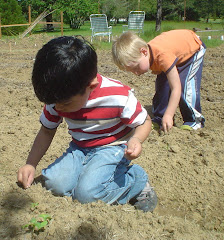
Young people in the garden: The last day of school is June 10 but we're already receiving lots of help from some of the local young people. Weeding, mulching, planting seeds and transplanting starts...all these tasks provide meaningful activity and fun in a town without much else to do after school. One afternoon last week we had five kids stop by; some just to visit, and others to help out.
Seth and Ricardo take lettuce home to their families after helping us mulch the garden paths
Volunteers: We've got some new faces and many of the core group of volunteers coming back from last year. Today we had five people helping with the harvest and other tasks. These included Pastor Mark Peterson from the nearby Monroe Church of Christ, Jim and Cindy Kitchen who are the coordinators for a garden modeled after the Sharing Gardens, in Corvallis and Larry Winiarski who went above and beyond the call of duty and patiently took apart our donated lawnmower that hasn't been working at all this season. He finally sleuthed out the problem and got her running! Now maybe our garden paths won't look quite so shaggy. Thanks to all the rest of you who have been coming out to help.

Jan, spreading mulch
Jennifer and Llyn planting tomatoes
Larry (the lawnmower doctor) starting seeds at the Monroe garden
The gardens are starting to take shape. We've been preparing beds and planting almost every day. Here are some pictures of the garden's progress:
"Butter Crunch" lettuce
Pepper plants interspersed with red lettuce. The lettuce will be harvested before the peppers get too big.

Much thanks too to all the people bringing us your used pots and flats. We're glad to give them new life. Phyllis Derr has been calling us to pick up her lawn clippings in Monroe. We use them to mulch. We've received financial donations since our last post from Jennie and Kris Rhoads, Craig Erken, Karen Josephson, Angee Costa and Chuck and Betty Conway. And thanks to Steve Rose who, once again has grown hundreds of tomato starts which he gives away to food-bank recipients, volunteers and provides us with the surplus at the Sharing Gardens. 

It looks like we'll have quite a few extra tomatoes to give away. First come, first served. Stop on by the Monroe garden during volunteer times if you'd like to take some home to your own garden.

Wednesday, April 20, 2011

Happy Birthday! - Sharing Gardens

Dustin digging onions
The "Sharing Gardens" turned "two" on April 15th! Hard to believe it's only been that long...This past few weeks we've been dodging raindrops and spending time transplanting and preparing beds with the trust that sunnier weather is on its way. Our young friend Dustin McClintock showed up to help us dig up the last few onions that wintered over. We always appreciate his willing smile and "can-do" attitude!

Doreen transplanting
Doreen Millar managed to join us a few times already this season. She and her husband Rann were some of our most dedicated volunteers last year. Here she is transplanting out a few lettuce plants. The slugs are getting plump on many of our early transplants. It's a good thing we have many more at "The Ark" - greenhouse - awaiting their turn to be planted out.

4-H Giveaway
We enjoyed our time at the 4-H Giveaway on Saturday, April 16th. Chris and I brought a whole table-full of starts: broccoli, lettuce, kale, spinach, amaranth and sunflowers. It was fun to see the smiles of people taking their free "starts" home for their own gardens. The young people in Christie Warden's 4-H group did a beautiful job of putting on the event. They volunteered their time to set up, be there for the day and clean up the leftovers. It felt good to see all these young people being in service to their community.

Many of our wishes have been granted (we'll write up a thank-you blog soon!). Take a look at our current wish-list to see if there's anything you can help us with:

Our Current Wish List

Christie Warden - 4H leader and Ismael Ramos, one of the young people in her group.

Thursday, March 24, 2011

Growing Gratitude

Have you ever noticed how plants grow exponentially? At first you plant the seed and it seems like nothing is happening for the longest time; then, the first simple leaves appear and you can hardly perceive their daily growth.Given the right conditions: a larger pot, enriched soil, water, warmth and light and suddenly the leaves are lengthening and multiplying almost visibly! The "Sharing Garden" project of Alpine and Monroe, OR seems to be coming into that super-growth phase. So much to be grateful for!
Volunteers at the Crowson/Monroe garden - 2010
Big thanks to Chester Crowson for giving us permission to garden on his property in Monroe for another year. The Monroe gardens are ideally located behind the Methodist Church on Coon Rd. which houses the Food Bank (the greatest recipient of our produce). The garden is huge (110' x 170') and we were only able to cultivate about half of it last year. There's a garden shed  we use and Chester pays our water bill. His daughter, Lisa Richter has been a big help as liaison between the project and her Dad.

We continue to have very positive response to the articles that the Tri-County Tribune is publishing about us. Thanks to the editor, Gini Bramlett and her support staff. The paper reaches a different audience than the posts we write for our web-site and many new "locals" are becoming involved as result. One of these is Barbara Standley who donated several stacks of home-built nursery flats and the 6-packs to go with them. She and her husband Waldo started "Victory Gardens" on River Rd in Santa Clara back in 1968. Waldo was single-minded with the nursery and would have grown only tomatoes if his friends hadn't said, "You've got to branch out and grow other things!". Eventually they added flowers and vegetable-starts to their repertoire. Their nursery was active until 1996 and lay dormant till recently when the Standley's daughter and son-in-law began to revive the business - renaming it the "Grateful Gardener".

Barbara Standley and Llyn load her donation in the truck
We've had a nice response to our request for help to create re-usable leaf-bags. Two local seamstresses have stepped forth and are poised to make the bags once we get more drapes and other heavy fabrics donated. Our vision is to distribute these reusable leaf bags, for people to fill themselves and drop off at the garden sites or, for those who are unable to do their own raking to circulate a team of volunteers for leaf collection through-out the Fall. We use the leaves to mulch the garden beds and feed the worms and bacteria in the soil. John Noreena and Jenny Grey donated four HUGE, heavy-duty bags that were originally used to deliver sand to a job-site but that he has used for leaf-collection on his own property.

Germaine and Larry join us in the greenhouse. So much fun!
People have started to step forth and volunteer their time in the greenhouse. We've begun a partnership with Albany's YMCA (more about this in a future post) and they've been coming to the greenhouse to learn the art of nursery work as they grow out the "starts" they'll use in their own food-give-away garden. Kyle Rd. residents Larry and Germaine Hammon were a great help in transplanting sunflowers into bigger pots. Bruce Hayler - host to "The Ark" and the Oak St. "Sharing Gardens" also keeps coming over to get his hands in the soil.
  
Bruce Hayler and Chris planting lettuce in donated "plug trays"
We want people to know that our thanks goes out to all the people behind the scenes and those we've fail to specifically mention, whose support makes this project possible. The anonymous donors who drop things off at the garden sites, the well-wishers who think warm thoughts and send notes of appreciation and those who help to spread the word by forwarding our posts/articles. You are the light, the water and soil that makes it possible for the "Sharing Gardens" to blossom.

Current Wish List: Heavy fabric (drapes, shower curtains, canvas), at least 3' x 5' - to sew leaf bags out of. T-posts (slightly bent, OK). Nursery pots and flats (six-packs and large 4" sizes). Mud boots - various sizes for people to use when they come to the gardens.

We have available: Thornless ever-bearing raspberries: the canes are coming up and already getting leaves so the window is closing to transplant to your garden beds. They like full sun and well-drained soil. Let us know you're interested and we'll tell you where to dig them up.

Chris and Llyn can be contacted from 8:00 am to 1:00 pm and 3:00 to 8:00 pm - (541) 847-8797

Thursday, March 10, 2011

"Sharing Gardens" Potpourri

Liz Hayler at the greenhouse.
The community support for the "Sharing Gardens" is growing. We send out thanks to Warren and Laurie Halsey for donating two, unopened 5-gallon buckets of house paint. We can spruce up the bathroom at the Alpine Garden--inside and out and use it for other garden projects as well. Our continued gratitude goes to the Canters and Haylers who are hosting the greenhouse on their property in Monroe.

A big thanks goes out to Bud Hardin of Monroe. He has donated the funds to cover the cost of renting a portable toilet for a full year! This has been placed between the Monroe Garden site and the Food Bank. Since the closest public bathroom to the site is several blocks away, there are many volunteers in both programs who will be very glad of this donation.

Linda with a Mason Bee house.
Linda Zielinski has given us a "starter" batch of Mason Bees (Osmia Ribifloris). These industrious pollinators do not build hives but lay eggs in tubes which they seal off with a daub of mud (hence their name). Since they have no queen or honey to defend they are easy-going and will not sting unless you step on them or squish them in some way. For this reason they are ideal to keep in your garden if you have children nearby. They have a fascinating life-cycle which Linda is going to write about and post to this blog in the coming months.

As we were sending off the final draft of our Wish List to our local weekly paper (Tri-County Tribune) for publication last week we added, almost as an after-thought, our need for a small utility trailer. Over the weekend we got a call from Dick and Jan Skirvin, life-long residents of the Tri-County area. They had a trailer they could donate! They had found it decades ago, when they first took over the family homestead. It was lost and buried amongst a wall of Oregon's famous blackberries. Dick and his son resurrected the trailer and it served their family for many years. They no longer have use for it and so now, with a stiff wire-brushing and a fresh coat of paint it will join the ranks of refurbished garden-equipment at the "Sharing Gardens" and along with the wheelbarrow just donated by Brigitte Goetze will serve for many more years to come.

Dick and Jan Skirvin with their donated trailer.
We are happy to say our wish list is dwindling. Our main need at this time is for some bailed hay or straw that we can put down on the floor of the greenhouse. Even though it is fully covered and sealed, the ground below is wicking moisture from the surrounding field and the paths are really mucky. We realize that most people with livestock wait until the new hay is coming in before they get rid of the old so we'll probably just buy some bails. If you do have some moldy bails to donate, we can come pick them up. Just let us know.

Something else to keep on your radar screen: Next fall we're going to have a volunteer team of leaf-rakers go around the area and bag up leaves to mulch the garden. We'd like to sew a few dozen re-usable leaf bags out of drapes or other sturdy material. So, if you have fabric you think would be appropriate and/or you are a seamstress and would be willing to sew a few of these bags to help out the project, let us know. Our current Wish List

Mason Bee
If you have sprouting potatoes and don't wish to grow them yourself, we'd be happy to grow them in the "Sharing Gardens". if you'd like to plant them in your own garden, follow this link to learn how.
Why grow your own. How to "chit" potatoes

Sunflower seeds are a great crop to grow; the seeds can be harvested and sprouted for winter greens, they make great bird food for our wild friends and they are a beautiful border on the north side of any garden.
How to Grow Sunflower Sprouts

Thursday, March 3, 2011

Sharing Garden Update

We have much to be grateful for!

Karen and Chris unloading barrels
Karen Finley, of Alpine's Queen Bee Honey drove with Llyn down to Eugene and back and loaded twenty recycled 55 gallon barrels donated by Glory Bee Foods onto her truck and brought them back to the greenhouse. They are set up to support our potting tables and, once filled with water, will provide thermal mass--moderating the temperature of the greenhouse year round. The water-filled drums will absorb the heat from the sun, or the woodstove, during the day and release it slowly through the night.

A sample of our seed bank.
We received a seed-donation from Brigitte Goetze of Alpine. All together we had three lidded buckets full of seeds - most of which Chris saved systematically over the course of last year's harvest. We sorted through them and determined which ones we could give away and have been sharing them with other gardeners, and people growing food for those in need.

We are grateful to the Tri-County Tribune for offering to print our complete wish-list and an explanation of the "Sharing Garden's" purpose. The article has only been out two days and we've already received a donation of over 2000 "plug trays" from Frank Pitcher who grows cabbage-seed commercially. We haven't decided if we're going to cut them up with a razor knife - to be able to give away smaller amounts of starts (there are 128 holes per flat!), or if we'll plant multiple varieties of seeds on one flat to have "variety-packs" we can give away. We'll put the word out when we have seedlings available.

Bruce and Chris planting seeds
Today we got some breaks in the rain. It's amazing how fast the greenhouse heats up as as soon as the sun comes out! We all peeled down to tee-shirts though the temps were still chilly outside. Bruce Hayler showed up to give us a hand. Though he's been a gardener for many years, this will be his first experience in a greenhouse. We sifted potting soil, added some fertilizer and sifted rabbit manure and, between the three of us started seven flats of seeds. It's starting to really feel like a greenhouse!

We've received a beautiful green-painted mailbox from Renee and Johan Forrer of Monroe. We'll put that up in Monroe once the season gets going and it will be a place for plastic bags and a harvest knife for people to pick produce. Save your clean, plastic bags for us to use during harvest season!

If you need thornless ever-bearing raspberries, contact us and we'll arrange a time to show you where you can dig them up. We can supply pots if you need them for transport. Our contact info.

Here's a link to our updated wishlist. New items include: water-based exterior house paints, a wheelbarrow or garden-cart and, though we received all the plug-trays from Frank today, we still especially prize the standard "six-pack" size so let us know if you have some you don't need. Even a small amount helps.

Garden Tip: If the ground where you live is still too cold and soggy for planting peas, try this method we used last year with great success.

Another beautiful rainbow over "The Ark"

Tuesday, February 22, 2011

Wishlist and Thanks

Our new greenhouse. We've decided to name it "The Ark".
Here's a beautiful picture we took at the greenhouse on Monday. As you can see it's close to being finished. If you're local, you can see it at the far east end of Oak St., in Monroe (near the Long Tom River), just north of the storage lockers. Though we still have a list of "finishing touches", we've already started our first batches of peas and onions in pots.

We've got an updated wish-list. Let us know if you can help us out with any of these things:
Here's the mailbox we re-decorated for the Alpine Garden
* Hardi-Plank - scraps would be fine. We need it to skirt the greenhouse
* Pine Needles (the long ones from Ponderosa Pines are best) - we'll use them to
      keep the paths in the greenhouse from getting too squishy. We can come rake
      and bag them.
* Bedding straw - spoiled OK - we can use this for the greenhouse paths too, and
      any extra we'll use to mulch the gardens.
* An old mailbox - we need to paint one and set it up at the Monroe garden for
      plastic bags and messages (like at Alpine)

Still on our list:

*  Nursery flats, pots, 6-packs: Our vision is to grow enough garden "starts" to supply the "Sharing gardens" and to give the surplus away to volunteers and others who have donated in some way; to other "Sharing Garden"-type projects and to people in need in our community. We are in greatest need of 6-pack sized pots and prefer not to buy them new if we can find them to re-use (keeping them out of the waste-stream). Even a few will help as, if everyone donates a few, we shall have enough for the whole project. You can drop them in front of the garden shed at the Monroe garden, behind the big, white Methodist Church in Monroe.
*  Bagged leaves - bring to Alpine or Monroe and leave by the gate
*  Truckload of potting soil - delivered to greenhouse on Oak St. in Monroe
*  Sprouting Potatoes
*  Non-Hybrid Seeds
    Cash donations are always appreciated!

    Gratitude goes out to:

    * Steve Rose - for the beautiful job he did pruning the apple tree at the Alpine Park - the branches are available to anyone who wishes to process the wood.
    *  Judy Todd - thank you for your generous cash donation
    *  Betty and Jim Christensen - your cash donation is also a big help!
    *  Julia Sunkler of "My Pharm" - donated a load of rabbit manure
    *  George and Claudia gave us all the pellet-bags they saved from running their stove this past winter. They're made of heavy-duty plastic and so can be used over and over again.

    Chris in the door of "The Ark" greenhouse

    Friday, January 14, 2011

    "Sharing Gardens" Update and Wish List

    In this post you'll read an update on the "Sharing Gardens" - including construction of our 20' x 100' greenhouse, our vegetable plant give-away, our youth-garden program starting in the spring and see what's on our current wish-list.

    So far, we've been blessed with a relatively mild winter here in Alpine/Monroe, and we've been able to move forward steadily on greenhouse construction.

    We'll be writing a full handbook on all the details of the hoop-house construction which will be available as a PDF, so we won't go into details here on the blog about how its done. The short version (according to Chris, who's built many of these hoop-style greenhouses) is that the greenhouse is about half-way done. We figure we're still on track to complete the project sometime in February.

    This will give us plenty of time to get seeds started for this year. We're going to be growing a great abundance of starts this year. "Enough and to spare...to give and to share." These will be available to everyone for free. We'll let you know when they are available for you to bring home to your own gardens.

    We have a short wish-list of materials we need for the greenhouse and garden project. If you can help us out with any of these things, please send us an email, or give us a call.

    nursery flats and containers
    6" stove pipe, 2 adjustable elbows and a cap
    treated 4 x 4's  - 6 feet or better
    dry, spoiled hay ( we can arrange to pick it up or give you some gas money)
    bagged leaves to either garden site
    cedar or redwood fence or deck boards
    cash donations
    (make checks to Alpine Community Center - "Sharing Gardens" and mail to PO Box 11, Monroe, OR 97456)

    Bruce, Rann and Doreen preparing beds. Note heavily mulched paths.
    Other garden news: This spring we'll have three volunteer times. Wednesdays will still be at the Alpine Garden. Thursdays will be at the Monroe garden (times to be determined on a week to week basis). We're going to add a third garden time on Monday afternoons right after school. These will take place either at the Monroe garden or at our new greenhouse. Though young people ages 9-18 will be welcome at all three weekly sessions, due to school hours they probably won't be able to participate on Wednesdays or Thursdays till summer so the Monday sessions will be focused on including them in the garden project. We need some committed adults who would like to join us for the Monday sessions and mentor the young people in gardening skills. We're also wanting to connect with young people who have a sincere interest in learning to grow food and who wish to be of service to their community.

    Chris with a 4-H class he led in California.


    Gratitude goes to:
    • the anonymous leaf donors at both garden sites - keep 'em coming!
    • Renee Duncan - we're finally using the cedar boards you donated last summer. There will be many happy bird families with new nesting boxes in the spring, thanks to you.