Our new and improved site

(with the same content as this one, AND MORE!) is

www.The SharingGardens.blogspot.com/

Showing posts with label lettuce. Show all posts

Wednesday, November 13, 2019

Lettuce: From Seed to Feed - Part 2: Saving Seed

By Llyn Peabody 

If you grow your own lettuce, as the weather warms, it's not uncommon to have some of it "bolt" (try to go to seed). Saving lettuce seed is fairly easy and a good entry-point for those new to the process. Here is a re-publishing of a post we wrote back in 2011 but the information is just as relevant today. Happy seed-saving :-).

Saving your own seed is an important aspect of developing local food self-reliance. Relying on commercial seed farmers may become increasingly unreliable as climate change disrupts weather patterns and seed crops falter. Growing your own seed slowly modifies your plants to be uniquely suited to your micro-climate and growing conditions. Networking with other seed-savers in your area builds a sense of community. LINK: Locally Sustainable Gardening in the Face of Supply-Chain Shortages
 
Lettuce flowers - close-up.

Seed-saving can seem intimidating at first. I know I felt that way. Many vegetables will cross with their neighbors yielding inconsistent results. There are many questions that must be answered before moving forward. For this reason I definitely recommend Suzanne Ashworth's "Seed to Seed". It is a comprehensive manual that covers all aspects of seed-saving. I am also grateful to my husband, Chris, for all he has taught me from his 40+ years of gardening. He's helped me translate the book knowledge into experiential learning. Saving seed appeals to the outlaw in me, I guess. Like treating illness with herbs I grew myself, there is something empowering about developing skills usually left to "the experts". As it turns out, it's not really that difficult at all.

"Red Sails" lettuce - blooming.

Saving Lettuce Seed: Like most things in gardening, a bit of forethought goes a long way. Ashworth recommends 12' - 25' separation between types of lettuce to prevent cross-pollination (the farther the better). Plan your plantings (and harvesting) to leave sufficient distance between the flowering plants. Though you may have enough time to bring a Fall crop of lettuce to seed, we usually do our seed-saving with the lettuce we plant in the Spring.
 
Note: Be sure there is no wild lettuce that is forming seed near the varieties of domesticated lettuce you are saving seed from as it can cross. The plants that grow from these crossed seeds tend to be more bitter and course. There are several varieties of wild lettuce; this one is named Lactuca Serriola LINK.

Lettuce bolting - Black-Seeded Simpson

 Lettuce is an "annual" crop. This means that the plants will produce seed in one season (without over-wintering). As the weather gets hotter and drier you will notice on romaine or "leaf" lettuce a definite lengthening of the plant. ("Leaf" types form a loose rosette of leaves but not a tight "head). When it lengthens, it is starting to "bolt". Lettuce that is bolting gets noticeably more bitter (probably nature's way of protecting the plant in this important phase of its reproduction). On "head" lettuce (such as Iceberg), Ashworth says it can be helpful to slit the head, forming a cross-cut with a sharp knife, making it easier for the flower-stalk to emerge. She says some gardeners strike the head of the lettuce with the palm of their hand thus breaking the leaves away from the stalk. Without some effort to free the flower-stalk, head-rot from heat and humidity may kill the plant before it can go to seed. So far we have saved seed mainly from "leaf" lettuce. This summer we will experiment with our red and green "head" lettuces to see what works best for us and report back.

Lettuce marked for seed with bamboo.

As we are gardening with a group of people, we have found it essential to clearly mark the plants that we are saving for seed, so they are not harvested by accident. We have made small tipi's with bamboo sticks, tied a red ribbon around the plant or put a small sign on a stake and driven it in nearby. Even a plant that is obviously past an edible stage for harvest is not safe as a well-meaning fellow-gardener may assume the responsible thing to do is weed out your seedy lettuce plant and toss it on the compost pile!

Staked lettuce - the flowers get heavy.

As the flower stalk grows it will produce a big head of flowers. You may need to tie it to a stake so it doesn't fall over. Seed production occurs 12 - 24 days after flowering. Ashworth says you can harvest seeds daily by shaking the stalk over a large paper sack. The ripe seeds will fall into the bag. The method we have used is to wait until the majority of seeds are ripe and to cut off the whole flower head and place that in a paper sack. Leave the sack open in a warm, dry place (like the top shelf your tool shed) until the flowers are thoroughly dry. Be sure to label the bag with the name of the lettuce variety. If mice are a problem and you have the space, try hanging the open bag from rafters.

To winnow the seeds, roll the flowers between your fingers and the palms of your hands to free them . Lettuce seed is challenging to separate because the seeds are not much heavier than the chaff. Patiently drop small amounts of the seed/chaff over a tray, from a height of a foot or two while blowing gently. The seed should drop and the fluff blow away. Some people run the seed through screens but we have not tried this method. Commercially available seed-sifting screens are another option. They have different sized holes.

Put ripened lettuce flowers into a paper bag to finish drying.

Lettuce seed will remain viable for 2-3 years if kept in a cool, dark place, in an air-tight container.


The Sharing Gardens is a non-profit and tax-exempt organization. We exist entirely through donations. If you have found benefit from our project or our site, please consider making a donation through PayPal. (Click button below.)

Friday, June 10, 2011

Giver's Gallery, Gratitude and Updates

Lettuce ready for planting - April 2011
We've been watching the dramatic weather world-wide; floods, droughts, tornadoes, hurricanes, heat waves and record snows! It seems more important than ever to be helping people learn this basic skill of growing food while building community ties amongst neighbors. We are very grateful for the surge of support that has come to us since we lost greenhouse access and the big grant we applied for. All told, we received close to $2,000 in donations from people near and far. We have also received materials donations and the warming weather here in the Pacific NW has brought out droves of volunteers, both new faces and familiar friends from last year.

Our garden "palette" to choose from - May 2011
We have been moving forward in faith, trusting that there is some greater purpose to recent events. We don't want to miss it by wallowing in regret or judgment. We feel on-purpose again and happy to honor the commitments we have for growing food for those in need, and continuing to develop this model of gardening that builds community and helps increase local food security. We have some exciting prospects calling us forward and are freeing-up our energies to pursue those. Thank you to everyone for your wise words and all the ways you have shown us that this program matters to you. It has really helped.

A few highlights since our last post:

Jan with lettuce for the Food Bank
Harvest has begun: We've begun to harvest from the gardens! The cool, wet spring has been very good for our lettuce and kale. Volunteers have been taking home as much as they can eat, we took thirty lettuce-heads to the food bank last week and another twenty to the Monroe Legion Hall: they serve lunch to seniors twice a week and appreciate the fresh vegetables we're able to provide. The seniors take home whatever isn't used in the lunches. This week's lettuce harvest was over 40 heads!

Llyn with spring's bounty!
Straw delivery: We are extremely grateful to Mark Frystak, a resident of Monroe who saw our recent wishlist posted in the Tribune News and came through with 55 bales of straw for us to begin to mulch the gardens. Everyone agrees that the straw makes the garden look so tidy, volunteers love the dry comfort of weeding from straw paths and the worms, snakes and other garden-friendly wildlife appreciate the food and shelter it provides. We can still use much more straw, and will continue to have need all through the season. We used about 10 tons last year and had about a third less garden in cultivation. If you know of anyone with bales to donate, we can probably arrange for pick-up. Here's a link to our full wish-list.

A-Frame - tomato cages with mulch on the paths
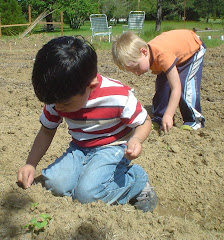
Young people in the garden: The last day of school is June 10 but we're already receiving lots of help from some of the local young people. Weeding, mulching, planting seeds and transplanting starts...all these tasks provide meaningful activity and fun in a town without much else to do after school. One afternoon last week we had five kids stop by; some just to visit, and others to help out.
Seth and Ricardo take lettuce home to their families after helping us mulch the garden paths
Volunteers: We've got some new faces and many of the core group of volunteers coming back from last year. Today we had five people helping with the harvest and other tasks. These included Pastor Mark Peterson from the nearby Monroe Church of Christ, Jim and Cindy Kitchen who are the coordinators for a garden modeled after the Sharing Gardens, in Corvallis and Larry Winiarski who went above and beyond the call of duty and patiently took apart our donated lawnmower that hasn't been working at all this season. He finally sleuthed out the problem and got her running! Now maybe our garden paths won't look quite so shaggy. Thanks to all the rest of you who have been coming out to help.

Jan, spreading mulch
Jennifer and Llyn planting tomatoes
Larry (the lawnmower doctor) starting seeds at the Monroe garden
The gardens are starting to take shape. We've been preparing beds and planting almost every day. Here are some pictures of the garden's progress:
"Butter Crunch" lettuce
Pepper plants interspersed with red lettuce. The lettuce will be harvested before the peppers get too big.

Much thanks too to all the people bringing us your used pots and flats. We're glad to give them new life. Phyllis Derr has been calling us to pick up her lawn clippings in Monroe. We use them to mulch. We've received financial donations since our last post from Jennie and Kris Rhoads, Craig Erken, Karen Josephson, Angee Costa and Chuck and Betty Conway. And thanks to Steve Rose who, once again has grown hundreds of tomato starts which he gives away to food-bank recipients, volunteers and provides us with the surplus at the Sharing Gardens. 

It looks like we'll have quite a few extra tomatoes to give away. First come, first served. Stop on by the Monroe garden during volunteer times if you'd like to take some home to your own garden.

Thursday, June 24, 2010

"Lettuce" Be Thankful


Summer weather has finally arrived and with it the garden is growing exponentially! We have an abundance of lettuce in Alpine and the earlier plantings are starting to bolt. Please come share in the harvest, keeping in mind that the gardens are feeding many people -- only take what you know you can use. The "Sharing Gardens" are grown "for those who have contributed in some way and for local families in need".


You may harvest any of the lettuce in Alpine, with the exception of the heads we are allowing to "go to seed." The seed lettuce is clearly marked with a small tipi made of bamboo (see picture to right).

If your own garden is beginning to produce surplus that you cannot use, please bring it to the Monroe Food Bank behind the Methodist Church -- 648 Orchard St in Monroe.


Food Bank Hours:
10:00 am to Noon on 1st, 2nd, 4th and 5th Thursdays
5:00 - 7:00 pm on 3rd Thursdays

Thank you!

Thursday, June 10, 2010

How to Harvest in a Sharing Garden

One of the benefits of a cool and extended spring season is that the "greens" really thrive. It's time to start harvesting now and this post offers guidelines for harvesting in a "sharing garden".

Lettuce ready for harvest at Alpine site
Some people, when they first hear about "sharing" gardens feel a little anxious about how it all works out. "Will there be enough to go around?", "Will there be the kinds of vegetables I like to eat?" These are the kinds of questions that might be going through your mind. Most of us, raised in this culture, are taught to "look out for #1", to compete for our own "piece of the pie" and to move through life planning and strategizing for future security at the expense of present time enjoyment and trust that we will be provided for. Sharing Gardens are based on the premise that if we all start taking care of each other as if we are one big family, that there will always be enough to go around and all our needs will be met.


We are feeling encouraged in this second year of the gardens to see how many people are taking this spirit of sharing to heart. More and more people, from all walks of life, are showing up at the gardens and contributing at the level that feels good to them. For some that means monetary or material donations, for others its actual work in the gardens or behind the scenes and for others their contribution consists of offering kind words of appreciation or by pulling up a garden chair and keeping us company while we weed or mulch the beds. The principle behind the gardens is that "each gives according to ability and receives according to need."


So, back to the questions..."Will there be enough to go around?" - The answer is "Yes, of course," if those of us eating from the garden harvest "according to need". Only harvest what you know you can use and be mindful of the overall quantity of a crop. Currently we have lettuce galore, and much more to come. It's season is short so, if we don't eat it, it will just go to waste. Peas, on the other hand, are in a more limited supply so, if you're picking, try to leave a handful or two for someone else.


"Will there be the kinds of vegetables I like to eat?" In planning a Sharing Garden there are several factors that must come into balance for the garden's success.
  1. We aim to grow foods that people are familiar with, and enjoy. 
  2. We choose varieties that are suited to our particular climate and growing season.
  3. We find a balance of growing  foods that can be eaten fresh (lettuce, kale, broccoli, cukes, tomatoes) with those that can be canned/dried/processed for storage (tomatoes, cukes and other pickling vegetables) and root-crops for winter storage (potatoes, squash etc).
So, while everyone's specific and particularly favorite varieties may not be grown, our aim is to meet people's basic food needs. In future years we may be able to develop a level of coordination between people who maintain their own home-gardens whereby someone who has extra space can grow a few rows of something more exotic to share with others involved in the gardens.

Corn seeds saved from previous year's crop
Another important function of the Sharing Gardens is to save seed. This adds a layer of local food-security should supply-chains  break down. The advantage of having two sites--Monroe and Alpine--is that, for varieties of plants that cross-pollinate (squash for example) we can grow different species in each garden and keep the seed-strains pure. In future years we may call upon those with home-gardens to grow out a row of a particular strain of squash (for example) so we can have a greater variety while keeping  the seed-strains pure. This gardener would, of course, have access to the other varieties of squash being grown in other gardens. As we begin to trust the mode of sharing we see that our own needs are met as we care for the needs of the whole group.


We have a link on our website that will have updates on the vegetables that are ready for harvest in each garden. You can  click here or go to our website www.AlpineGarden.blogspot.com/ and see the links in upper right-hand corner. Click on "Ripe for Harvest!" for an updated list. When you click on the link, the harvest-list will appear as a blog-post in the upper left-hand corner of the website under the title "Ripe for Harvest!"

 Ripe for Harvest!

Tuesday, May 18, 2010

Planting Begun! Spring 2011

April and May have been unbelievably rainy here in the Willamette Valley of western Oregon. I don't know if we've set any records but the consistent and sometimes heavy rainfall has made it difficult to get into our new garden site in Monroe and do any tilling. When the soil is too wet it clumps together and then hardens into big chunks that are not conducive to growing vegetables. We've had a few stretches of dry, sunny weather but not enough to dry things out as deep as is ideal. Volunteer Steve Rose has been down to the site three times already this spring, mowing the long grass, "scalping" off the first few inches of grass-roots and soil and finally going another 4" down with the big tractor and roto-tiller attachment but he's had to hold off on going deeper while the ground has been too saturated.

Yesterday we had a little break in the weather (with more rain predicted in the forecast) so Chris decided we'd go down to the Monroe site and just see if maybe we could get a few things in the ground. Our timing couldn't have been better! We used our little red 1947 Farmall Cub, a fully restored tractor that was developed and used for "truck farming" - small-scale vegetable farms in the 40's and 50's before agri-business and the mega farms became the norm, to plow up a few beds.

Chris mounded up eight, forty-foot beds and three, twenty-foot beds. We planted 320' of potatoes (probably close to 400 chitted seed potatoes in all!), and the other three rows we filled with broccoli, kale and two kinds of lettuce that were beginning to get a little root-bound. Best of all, though the rain held off the whole time we were planting, we felt the first drops fall as we loaded up into the truck to head home for lunch and a siesta. Better yet, we were lulled to sleep and blessed with the sound of a steady rain falling on the roof of our home all through the night guaranteeing that the spuds and transplants are settled snuggly in their new beds. It won't be too long before we'll be harvesting the greens. 

More "thank-you's" are in order: Adele "Gia" Kubein donated a load of brand-new pressure-treated lumber and plywood. Kat Conn gave us four big, food-grade plastic buckets and a few dozen chitted potatoes. Thanks to Ray Kreth, we got a lawnmower! Phil Ezell has taken over the mowing at Bert and Theresa's place by the Alpine garden and been bringing us grass clippings for mulch. Renee Duncan has contributed a stack of weathered, cedar fence-boards that we can use to build birdhouses and feeders with the kids. Thanks to the folks at Ten Rivers Food Web who have been re-posting our blogs on their wonderful site. Check 'em out! Thanks too to all those people near and far who have been sending us notes of thanks and support, especially my mom, Judy Peabody (our biggest fan!) It really lifts our spirits! We apologize if we've overlooked anyone. Please know that you are all appreciated. After all, this is your garden too!

Wish list: Does anyone have a wheelbarrow or a garden-cart they'd like to donate?

 It won't be long now!