Our new and improved site

(with the same content as this one, AND MORE!) is

www.The SharingGardens.blogspot.com/

Tuesday, June 16, 2009

Garden Update

The garden is growing exponentially now!

Steve Rose broke ground with his tractor on April 15th, 2009. Here's a picture taken on May 12...


And another on June 13th, of basically the same view, a week ago...


Here's the bean tipi we built and planted on May 22...


And here's a close-up taken June 16, 2009. The beans are really thriving from the rabbit-manure tea we feed them once a week or so. The straw-mulch keeps the soil warm and moist which they like too.


Local Folks Mark Your Calendars: Third Sunday of July, July 19th, 2009 -- 6:30 The Corvallis Chapter of Oregon Tilth is hosting their monthly potluck and garden tour at the Alpine Community Garden.
This is a chance to meet other organic gardeners in the area, make connections and share gardening tips. We'll share food together, tour the garden and have a campfire in our new fire-pit! Children welcome. There are picnic tables at the park. you can also bring fold-up lawn-chairs or a picnic blanket.

Gratitude to Margi Willowmoon for the purple potato fingerlings. We've got almost 50 feet of them planted! And to Vicki Thompson for the green pepper and jalapeno starts. We found good homes for all of them. Thanks to any of you who came and picked up tomato starts. They're all gone now. We've got about 80 tomato plants in the garden itself; all different varieties. That oughta keep the Alpine-area real saucy come harvest-time!

Sunday, June 14, 2009

Re-Purposed materials

Most people have heard of the terms: Reduce, Re-use and Recycle. I just heard of a new term for something I've been doing for years and that is to "Re-Purpose". This means that you find a new purpose for things than they were originally intended, thereby keeping them out of the waste stream. Gardens provide fantastic opportunities for re-purposing. Below are some pictures of some of our re-purposed items.

Seedling starts in tofu containers. We drill holes in the bottom for drainage.


Cut a hook-shape off the ends of plastic coat-hangers. These make great hooks to keep soaker hoses in-place.


Twist-ties have hundreds of uses in the garden. Here we are fashioning a pole-bean trellis out of bamboo.


Here in the country, bailing twine is plentiful. We clip the bails close to the knots and then tie the twine end-to-end and wrap it around pvc-pipe for use in staking out rows etc. (A great rainy-day project or when it's too hot to be in the garden and you need an excuse to sit in the shade for a bit.)


Lastly, ever wonder what to use empty soy-milk containers for? We rinse them out really well, and pull them out flat (open up the folded corners and they flatten easily). You can cut them with scissors or, if you have access to a chop-saw, you can cut the ends off ten or more at-a-time.


When we first transplant young seedlings of lettuce or kale or any tender, young plants that are susceptible to cut-worms, slugs, bunnies or intense weather, we use the containers as a collar around the plant.

Check carefully to remove any slugs or unwanted bugs from around the base of the plant. Also pull away any clods of dirt or leaves they may be hiding under (you don't want to trap the pests in with your tender seedlings!) Open the container and  slip it around the plant and pin it in place with slender stakes, bamboo branches or some other narrow sticks at two corners. Make sure the collar comes in contact with the soil to keep insects from crawling underneath.  This technique also provides a micro-climate for your seedlings, protecting them from high winds. The foil liner of the containers reflect sunlight so the plants receive plenty of sun while they're small.


Soon they'll be peaking over the top and you can gently slip the collar off. Milk cartons work too. Milk cartons are also excellent to save for freezing applesauce and other liquid/semi-liquid foods. Because of their shape they are a very efficient use of freezer-space.


We'd love to see and share your ideas. Send us a photo and a short description and we'll share your ideas with others through our website. Just drop us an email: AlpineCoGarden@gmail.com -- Our website is http://www.AlpineGarden.blogspot.com/

Below is a link to an interesting article about a guy who gave me the idea for the term: re-purposing. He has built a sail-boat out of soda and water-bottles (called "Plastiki"). He's using it to bring awareness to the environmental problems posed by single-use plastic bottles.
http://www.dailygood.org/more.php?n=3717

Friday, June 5, 2009

Lets Do It!


Here is a short (5 min.) inspirational video about how the country of Estonia cleaned up all the garbage that had been dumped in its forests and wild-lands, in one day!

http://www.karmatube.org/videos.php?id=1590

Wednesday, June 3, 2009

One Cannot Live by Bread Alone...


It's time again for the Bread for Life program and Art at the Community Center.
First Thursdays of the Month - 3:30 - 6:00 in the Library in Alpine.
The next one is this Thursday, June 4, 2009.

Bring a portable project (knitting, small painting, jewelery-making
etc) or use the materials that are down there (paints/colored markers,
pencils, collaging, etc), or just come for the company and to see what
others are working on.

I'll have the library open for people to pick up bread from the Bread
for Life program. If the weather's nice, Chris Burns will probably be
gardening in the park across the street.

Young people of all ages are welcome as long as they're well-behaved
and pick up after themselves. :-)

If you have any questions, email me at AlpineCoGarden@gmail.com

Llyn Peabody

Alpine Garden in the News

We had a reporter and photographer come out to the garden last week and do an article about the Alpine Community Garden for the Gazette Times, the Corvallis daily paper. The article was featured on the front page and nicely outlined the garden project. Thank you Kyle, for the story and Casey, for taking pictures.

Here is a link to the article:
http://tinyurl.com/n64wwb


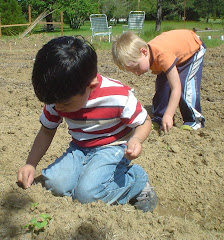
We've had some help getting the garden planted from some of the youngest members of the community. A few weeks ago preschoolers from across the road ventured over to the garden to poke sunflower seeds into the warm, waiting soil. As many of you know, who are following the blog, we grow sunflowers for their food value, as well as their beauty (they make delicious sprouts). We have two rows of the plants coming up from seeds we saved from previous gardens. We started ten plants of the Mammoth Russian variety too, from store-bought seeds. This variety can grow 8-10 feet tall and has the giant heads that can be a full foot across carrying hundreds of large seeds in each one. Sunflowers grown in the same garden can cross-pollinate, so if you want to have seeds that stay true, you have to only plant that one type.


We planted several varieties of pole-beans at the base of the sunflowers. We gave the sunflowers several inches head-start so the beans have somewhere to grow. These will be pretty and productive partnerships between the plants. (Below: pole beans coming up next to the bamboo tipi.)


We've got over half the garden mulched with at least a minimal mulching. Thanks to Lori of Alsea, OR who donated 3 tons of spoiled hay! We were only able to pick up one ton of it so far (due to our old funky 1968 GMC...we have to borrow a stronger truck if we're going to get the rest). Karen Finley - of Queen Bee Honey - turned us onto a big stash of dried grass clippings behind the baseball field across the street from our park. Also Rachel Unrein rescued some huge bales of rotting hay from her grandpas farm and brought those down to the garden. The moldy, rotten stuff, though not much fun to work with, is fantastic for the garden. Because it's already decomposing, the nutrients in the grass are more readily available to the garden. Also, the mold and rotting makes the grass seeds no longer viable which means less of them will sprout as weeds in bare patches of your soil. (Below: Our heavily mulched garden. Each hay "flake" is 4-5 inches thick. We lay them down side-by-side in the rows.)


The garden is almost totally planted now. We still have a few rows to fill in but the bulk of the planting is done. We want to thank Steve Rose again for contributing a box of starts to round out our garden. He gave us some hot pepper varieties, and early-bearing Stupice tomatoes (they're already setting fruit!). It looks like we've got the beginnings of some yummy salsa growing in the garden.

Just a reminder: For those of you growing your own gardens this year, it's not too late to plant a little extra to take and share with Food Banks and other support services in your area. Consider growing winter-storage crops such as squash and potatoes as these will 'keep' long after the last killing frost in your garden.

Here again is a link to the article: http://tinyurl.com/n64wwb

Sunday, May 24, 2009

Mulch-es Gracias


Alpine Community Garden - May 2009

The Alpine Community Garden is off to a great start! We've got all but about five rows of the 80'x 100' plot planted, and the fence (mostly) in place. If you live nearby, c'mon down to see the progress we've made in the last month. Remember, the Alpine Community Garden is growing food for the Monroe Food Bank, the Senior Lunch Program in Monroe and others in need in our community. "Give what you have, receive what you need." Contact us by email at AlpineCoGarden@gmail.com if you have donations, comments, would like to volunteer or would like to be added or removed from this regular blog-update. Also, if you are local and know of anyone with mulch materials who may not get this blog, please forward it, or give them our number. Thanks. Chris and Llyn 541-847-8797

Today's blog is about the benefits of mulching your garden. We are in need of significant quantities of mulch. Ideally we prefer bedding straw (either baled or raked out of animal stalls), spoiled hay (maybe you have some bails that are moldy or otherwise unsuitable for feeding to livestock that we could use in the garden), leaves from last fall (it's probably too late to rake them from under trees but if you've got a big pile we could collect, we'd be interested.) or grass clippings (either in a pile, or drying on your lawn, so we can rake them up) . Ideally, we'd love to have mulch-materials delivered to the garden but let us know what you've got and maybe we can come collect them from your home or farm.


Autumn Leaves Mulching the Broccoli and Peas from a Previous garden

The next big step for the garden's health involves a heavy mulching on the pathways between the rows. The method of organic gardening that we're doing focuses on feeding the soil and nourishing a healthy environment for worms, beneficial insects and micro-organisms. Soil is composed of sand, clay and decomposing plant/organic material (bio-mass). If these components are out of balance, crops will suffer. Mulching adds bio-mass to the soil, helps retain moisture (so you don't have to water as much) and, along with worm castings, compost and the small amount of organic fertilizer were adding, literally feeds your mini-livestock (worms, bugs and micro-organisms). They in turn correct the acid/alkaline balance in the soil, dig little tunnels that provide easy pathways for the plant's rootlets to grow into and digest the mulch thereby making all the nutrients locked into the bio-mass available to your garden, (worm poop (or castings) is like vitamins for your soil!) . Mulching also blocks weeds from getting sunlight so they can't grow, which cuts down on the need for weeding.

As we have prepared the garden this first year in Alpine, we dug soil out of the paths and heaped it in mounded rows. This makes the soil deeper and looser in the rows, making it easier for plants to grow. We will mulch heavily, primarily in the paths where we walk. Though we've got exceptionally good soil for a first-year garden, it seems that it has more clay than is ideal. The mulch we add in the paths between rows will decompose from sun and rain and worms and micro-organisms and make next-year's garden even better because of this added plant matter.

Many people don't realize that a plant's root system may reach out well into the pathways. Another advantage of mulching is that you make the soil less likely to become compacted in the pathways, and it's also more pleasant to be on your knees when weeding, or harvesting plants.

Here are the kinds of mulch we prefer, and why:


Bedding straw:
Straw is from the stalks left standing after grains are harvested (wheat, barley, rye). It consists just of the lower stems of the plant. We prefer the straw because it doesn't have as many seed-heads (which means less weeding for us). We can use straw straight out of the bale, or raked out of animal stalls. The benefit of used straw is that it contains urine and manure from the livestock which functions as fertilizer for the garden. We can also use spoiled hay. (Pictured at left) (If you are using straw or hay to build your compost piles, or deeply mulch your garden, please read our post about Herbicide Contamination of Compost, Manure and Mulch)


Autumn Leaves: Leaves from maples and fruit-trees are some of our favorites. In the fall we either put them directly in the garden rows so they will decompose over the winter or rake them into big piles and cover them in plastic for use in the spring. Not all leaves are beneficial. Walnut leaves (for example) are toxic to many plants and will retard their growth or actually kill them. (Below: A big load of autumn leaves diverted from the landfill/burn-pile)


Grass Clippings: Some people like to leave grass clippings on their lawns/fields because they act as a mulch and fertilizer for the growing grass. Other people have collection-bags on their mowers and pile their grass clippings in one place. Grass clippings make an excellent garden mulch and fertilizer as they are easy to spread and compost readily making the nutrients easily available to your plants. We don't recommend bagging up your lawn clippings because they will become a stinky, gooey mess if they decompose in an airtight container or bag. If you wish to save grass clippings for later use, either leave them in the lawn/field for a few days in the sun and rake them after they've dried or use your bagger-mower to collect and then spread them just a few inches thick on a large sheet of plastic, in the sun, and they will dry quickly. Then you can store them in bags for use at a later time. (Below: Spoiled hay mulching on a lawns-to-gardens project. Cox Lane Garden)


In this 'full-circle' style of gardening, we are always looking for ways to pull materials out of the waste stream (taking up room at the land-fill, or being burned in burn-piles) and save money by re-using and recycling. In the garden, "one man's trash" can truly be "another man's treasure". Let us know if you have any of these mulching materials available, so we can take them off your hands and turn them into 'garden treasure'. Chris and Llyn: 847-8797 AlpineCoGarden@gmail.com
Thank you to Gary Weems for donating time and materials to get the toilet working again at the Alpine Park. Thanks to Steve and Beatrice Rose for housing our tomato-starts in their greenhouse this spring. Thanks to Patty Parsons for writing the grant and to the South Benton Foundation for awarding our project $350 (this means that cash donations have now surpassed $1000.) Thank you to Dorothy Brinckerhoff for being our treasurer (and all-around go-to gal!). We also appreciate Phil Hawkins and Emily Smith for the picture spread and article that featured our Alpine Park clean-up day in the Tri-County news.


Fun in the leaf pile!